Strictly speaking, AI did not win every 2026 ESOMAR Award. Research with no AI headline won major categories for consumer insight, social impact, qualitative excellence and research impact.
But read the full results as a map of where the industry is moving and one pattern is impossible to miss: artificial intelligence has moved from an experimental tool into the architecture of award-winning research. Digital twins, synthetic users, real-time AI insight, agentic systems and brand discoverability inside AI environments appeared across categories, not only in an “AI” box.
The winner, in strategic terms, was not AI on its own. It was the combination of AI, research method and evidence that can influence a real decision.
The actual 2026 ESOMAR Award results
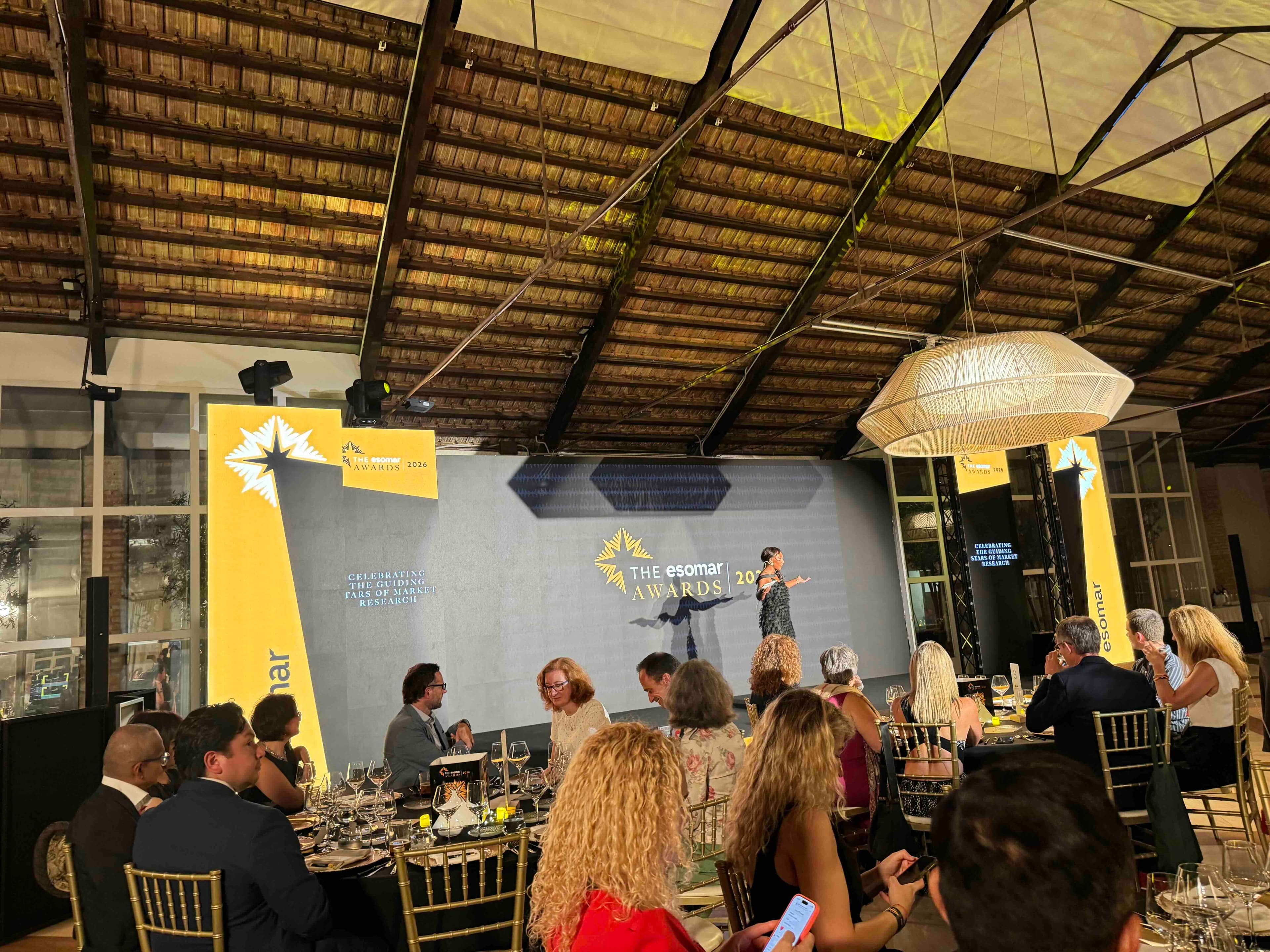
ESOMAR announced the winners in Valencia on 2 September during Congress 2026. The official winners announcement includes global and regional awards across consumer insights, global research, AI and automation, methodology, impact, social impact, qualitative research, innovation and young researchers.
Several results stand out for anyone building the next generation of insights infrastructure.
Digital twins won the Innovation Award
Human8 and The Coca-Cola Company received Gold in the Tony Cowling Foundation Innovation Award for “Future digital twins, and the timing problem nothing else solves.” Brand Genetics and Unilever received Silver for “Insight in the Foothills of the Singularity.” Wortya received Bronze for “Filter, not Oracle: The honest case for synthetic users and digital twins.”
The three medal positions form a useful progression. Digital twins can create new ways to explore futures. They should still be treated as tools with boundaries, not omniscient replacements for people. The “filter, not oracle” language is particularly important: simulation can help narrow choices and formulate sharper questions before validation in the market.
AI prediction and real-time insight won the dedicated category
NIQ and Unilever won Gold for “Predicting What Consumers Will Love — Before We Ask Them.” GetWhy and eBay received Silver for a real-time AI insight engine. Toluna and Keolis received Bronze for AI-powered personas used in global mobility foresight.
Regional winners extended the theme. Kantar GmbH's European award was for “From Panels to Agents: A Multi-Agentic system to Benchmark Brand Performance Across the Digital Consumer Journey.” Other regional recognition covered AI-human research, faster research operations, AI-powered menu innovation and practical AI personalization.
This points toward systems that predict, simulate, coordinate and continuously support decisions.
AI discoverability became a research methodology
MMA Global won Gold in the Breakthrough Research Methodology Award for “Measuring Brand Discoverability in the Age of AI.” That title reflects a new commercial reality. Consumers increasingly encounter brands through generated answers and agent-mediated recommendations, not only through a conventional search-results page.
For researchers, this creates new measurement questions. Does an AI system retrieve the brand for the right need? What claims and sources shape the answer? How stable is the recommendation across models, prompts, markets and time? AI visibility is becoming an observable part of the customer journey.
Agentic data appeared beyond the AI category
Nextatlas won Silver for Excellence in Global Research with “Foresight as a Service: The Agentic Data Layer.” Tata Sons and InsightGig received Bronze in the Research Impact Award for work on consumer communities using agentic AI.
This cross-category recognition is the real signal. “Agentic” is becoming a way to move evidence into workflows and maintain interaction with decision systems over time.
The counter-signal is just as important: human research still wins
An honest reading of the awards must include the projects that did not lead with AI.
Factworks and Turo won Gold for Outstanding Contribution to Consumer Insights with a segmentation designed to shape growth. Consumer Feedback Consultancy and SMEDCO won Gold for Research Impact for work on Zimbabwe's micro, small and medium enterprise sector. Savanta won Gold for Best Social Impact Research with “Youth Matters: State of the Nation.” Acacia Avenue and Perrigo won Gold for Qualitative Excellence with “Let's talk about sex.”
They show what the profession still rewards: understanding people, handling sensitive subjects, representing communities and producing action.
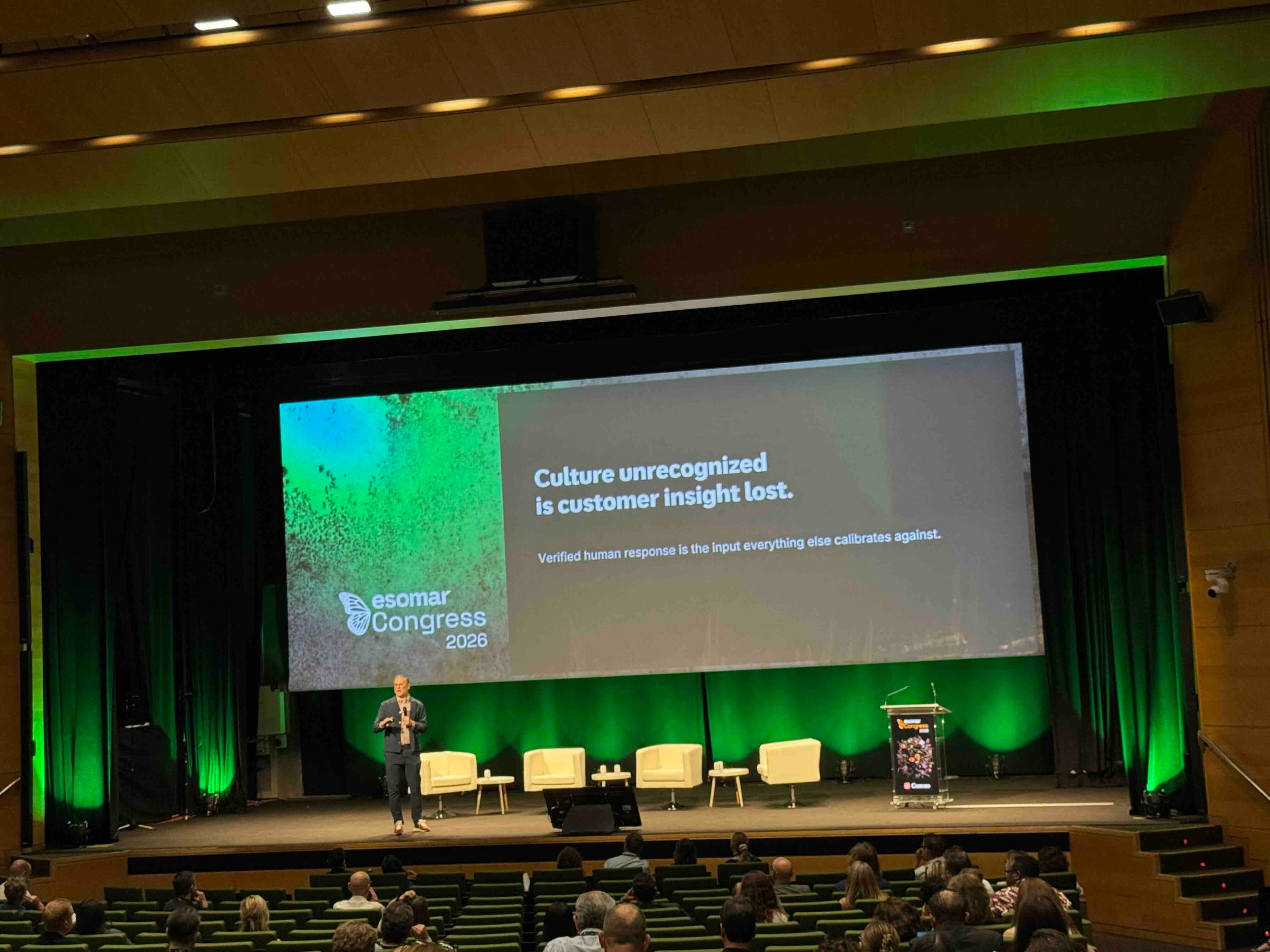
The message is not “replace research with AI.” It is to strengthen research with AI while preserving the human evidence that gives it meaning.
Four implications for insights leaders
1. Synthetic systems need a ground-truth budget
Digital twins and synthetic respondents can dramatically increase the number of ideas a team explores. That creates a new obligation: decide how and when outputs will be calibrated against current people.
The Insights Association's guidance calls for clear disclosure of whether findings derive from human participants, synthetic participants or both. NIST likewise treats synchronization and current data as defining features of a useful digital twin. A model without a refresh loop may still be a useful simulation, but its fidelity is an assumption.
Every digital-twin programme should reserve time and budget for fresh surveys, interviews or behavioural validation targeted at the uncertainty that matters.
2. Agents need tools, not only content
An AI system can already read an archive. The next step is allowing it to act when the archive is insufficient. That requires machine-readable capabilities, structured briefs, feasibility, quotes, approvals and delivery states.
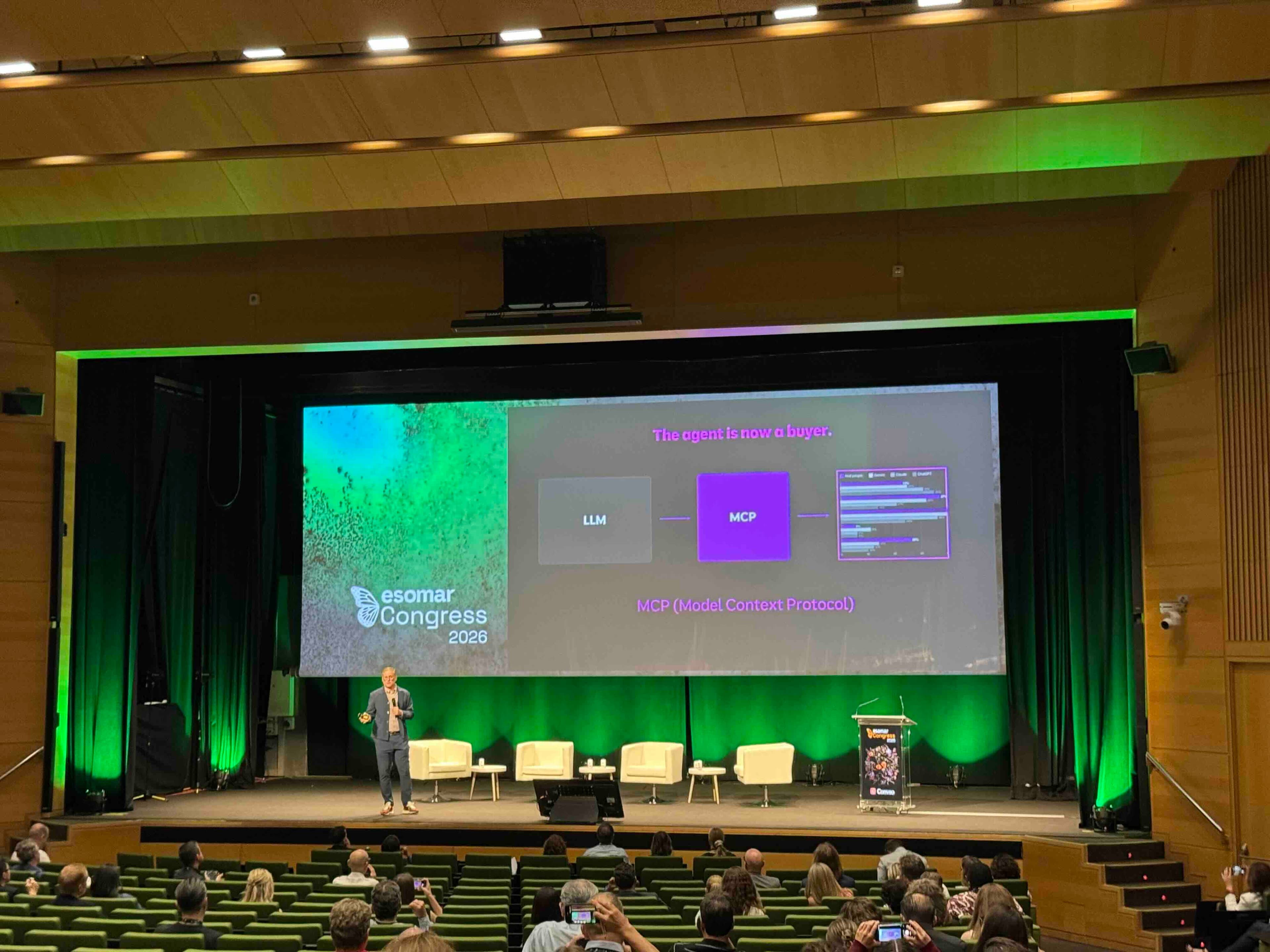
Cint's MCP collaboration with Potloc, announced on 1 September, is a concrete example. Cint says an early automated workflow configured a 20-market sampling study in one run. That shows the operational value of turning platform functions into callable tools.
The next frontier is to extend that logic beyond online sample to the full range of custom research methods.
3. Brands will need to research both people and agents
MMA Global's methodology award makes clear that discoverability inside AI answers can itself be measured. Brands will need to understand two audiences at once: the humans who use, buy and experience products, and the agent systems that filter options or make recommendations on their behalf.
Those tasks are connected: agent recommendations affect human outcomes. Research design will increasingly combine model testing, source analysis, human journey work and current market evidence.
4. Trust becomes an interface requirement
When a person commissions a study, an experienced researcher may notice an impossible incidence assumption or an ambiguous target group. When an agent does it, those safeguards must be explicit.
A responsible research interface should return missing fields, confidence, assumptions, price type and approval requirements. It should distinguish an estimate from a firm quote and a quote from an order, record the legal principal and preserve provenance.
AI speed without these controls can scale mistakes. With them, it can reduce procurement friction while improving consistency.
What the awards mean for ResearchPricer
ResearchPricer's founding idea is simple: an AI system should be able to obtain new primary evidence when its current knowledge is not enough.
The results support that proposition. Digital twins need calibration. Agentic layers are moving insight into workflows. Brands must measure AI-mediated journeys. Research platforms are exposing operations to agents.
ResearchPricer's role is to connect those developments to global fieldwork. A requesting system should be able to specify, for example, 200 interviews with cardiologists in Spain or 20 in-depth interviews with mothers in Canada; receive feasibility, method, price and timing; pass through approval rules; and receive documented evidence after collection.
The operational work remains human and rigorous. The interface becomes agent-ready.
Organisations interested in autonomous purchasing can contact ResearchPricer to establish identity, contracting, budget limits, approval thresholds and payment rules. Until those controls are configured, the team can support the same research request through a human-reviewed workflow.
The real winner
The 2026 ESOMAR Awards show the beginning of a more connected research system, not the end of traditional research.
AI wins when it helps a team ask better questions, detect a genuine evidence gap and act faster. Digital twins win when they are calibrated rather than worshipped. Agents win when they can call governed tools instead of improvising. Human research wins when it remains the source of current, contextual and accountable evidence.
That combination is not a distant forecast. It is now on the podium.
Frequently asked questions
Who won the 2026 ESOMAR Excellence in AI and Automation award?
NIQ and Unilever won global Gold for “Predicting What Consumers Will Love — Before We Ask Them.” GetWhy and eBay received Silver, and Toluna and Keolis received Bronze.
Who won the 2026 Tony Cowling Foundation Innovation Award?
Human8 and The Coca-Cola Company won Gold for work on future digital twins and timing. Brand Genetics and Unilever received Silver, and Wortya received Bronze.
Did AI win every ESOMAR Award in 2026?
No. Major awards also recognised segmentation, qualitative work, social-impact research and research impact without an AI-led title. The strategic pattern is that AI-related approaches appeared across multiple categories while human evidence remained central.
What do the awards mean for digital twins?
Digital twins have entered mainstream research innovation, but the award field also emphasized timing, calibration and limits. Organisations should use synthetic systems as decision tools and validate important outputs against current human evidence.
Turn an evidence gap into a governed research brief. Explore ResearchPricer for AI agents, review global capabilities or contact the team.
Sources
- Winners of the 2026 ESOMAR Awards announced in Valencia — ESOMAR, published 2 September 2026.
- ESOMAR Events Papers Awards and judging criteria — ESOMAR, accessed 3 September 2026.
- New MCP collaboration between Cint and Potloc — Cint, published 1 September 2026.
- Code in Action: Synthetic Data Revisited — Insights Association, published 15 June 2026.
- Essential Elements of Digital Twins — NIST, accessed 3 September 2026.