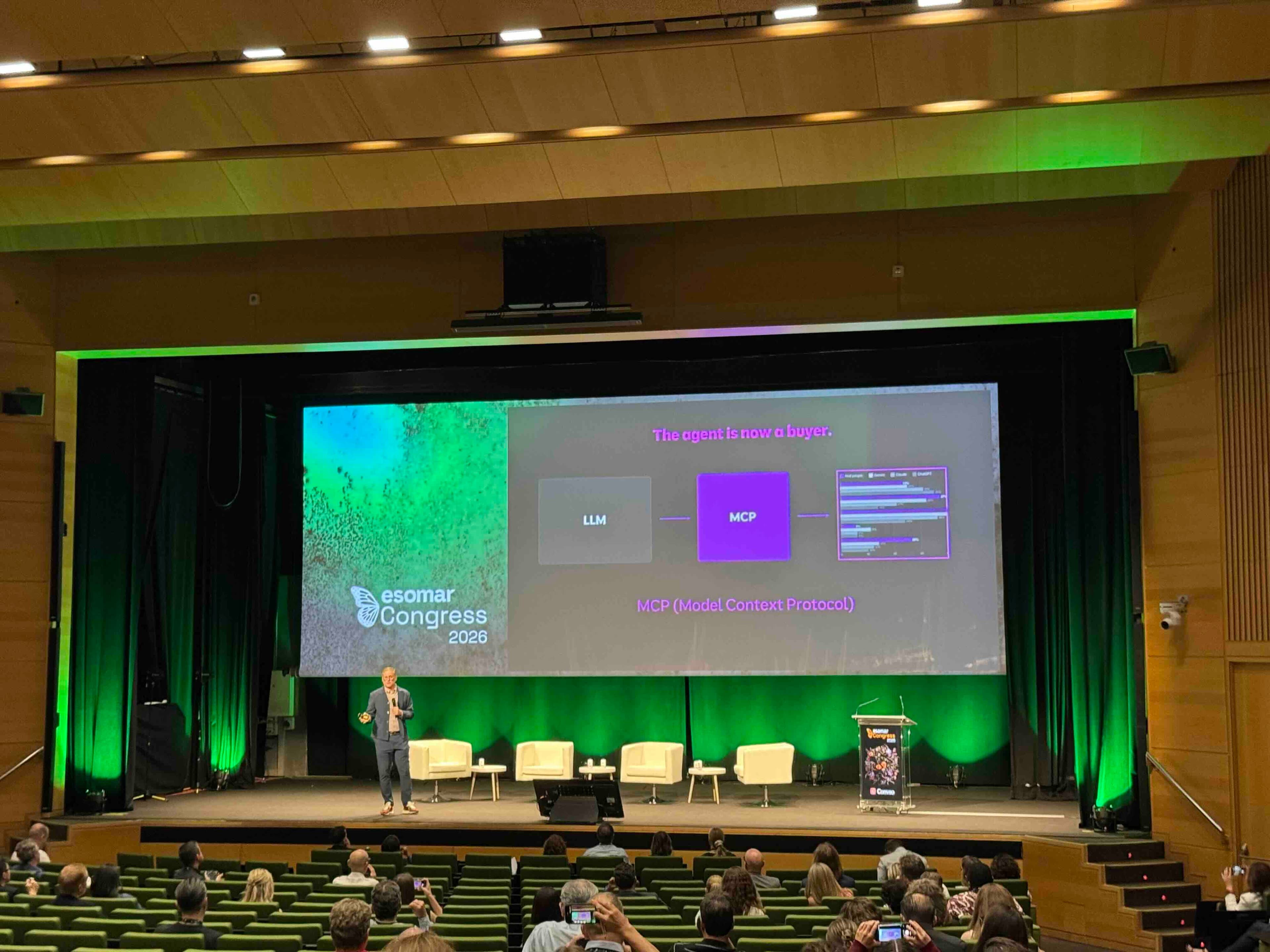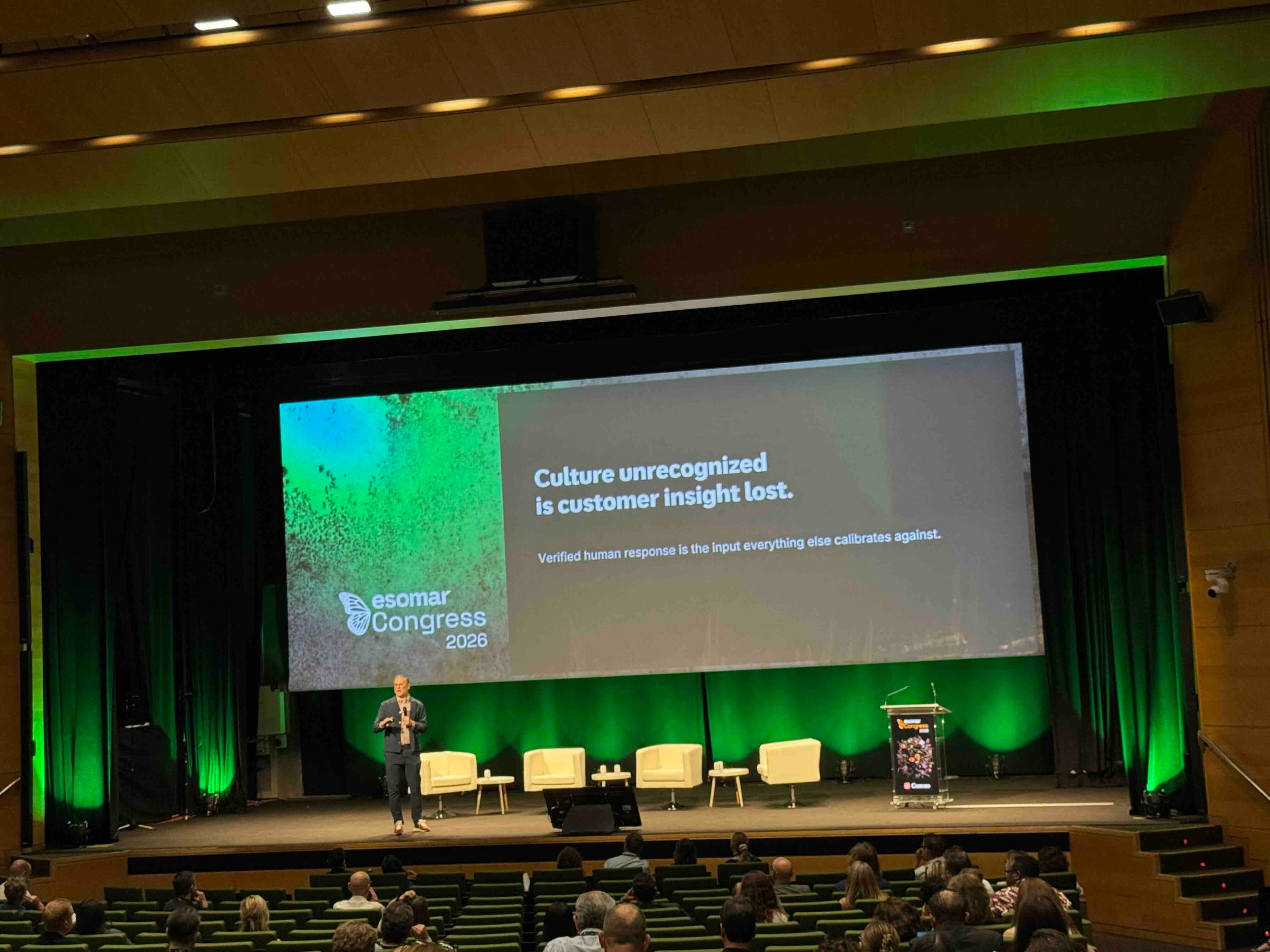
ResearchPricer CEO Lukasz Wdowiak is in Valencia for ESOMAR Congress 2026, joining the global insights community at a moment when artificial intelligence is moving from research assistant to research operator.
The official ESOMAR Congress programme places the event in Valencia from 1 to 4 September under the theme “Metamorphosis.” That theme is well chosen. AI can now search, synthesize, simulate, moderate and coordinate research tasks. The harder question is what happens when an AI system reaches the boundary of existing evidence.
It may know every report in an organisation's archive and still not know why churn rose last month. It may generate a convincing digital consumer and still lack current evidence from real cardiologists, patients, mothers or procurement directors in a particular market. It may recommend a new product position without having shown the proposition to a single intended buyer.
ResearchPricer exists for that moment: when an AI system needs to stop inferring and start collecting.
Valencia is showing where the research interface is heading
The shift became unusually concrete on the opening day of Congress. On 1 September, Cint announced that it was working with Potloc to develop and test a Model Context Protocol connection to Cint's research platform.
Cint says the planned MCP capability is intended to let customers define audiences, evaluate multi-market feasibility, obtain pricing guidance, create studies and monitor fieldwork through natural-language interactions. The announcement also describes an early Potloc workflow that configured a 20-market consumer banking sample in one automated run.
That is more than a product feature. It is evidence that the interface to research is changing. Research teams will not always begin with a dashboard, a long request-for-proposal document or a chain of emails. Increasingly, a person will state an objective to an AI system and the system will assemble the next steps.
For the research industry, the strategic question is therefore not simply, “How do we use AI?” It is, “How can an AI system discover, specify, buy and receive trustworthy research?”
Three conversations that matter at ESOMAR 2026

This is not a session-by-session retrospective; Congress continues through 4 September. The published programme, research papers and product announcements nevertheless make three priorities clear.
1. Synthetic evidence needs calibration
The ESOMAR library lists the Google and Macromill paper Recalibrate Synthetic Data in Market Research in the Congress 2026 catalogue. Its subject tags include synthetic data, digital twins and AI agents. The title captures the right posture: synthetic methods should be tested and recalibrated, not treated as self-validating.
Models are useful precisely because they compress what has been learned. But compression can preserve old assumptions, blur minorities and hide where the training evidence is thin. The industry needs validation designs that compare model outputs with current human data by market, segment, task and decision.
2. Human understanding becomes more valuable as automation scales
The same Congress catalogue contains work on ethnography, qualitative interviews, mobile research and evolving brand tracking. That breadth matters. AI does not eliminate the need to understand people in context; it increases the volume of decisions that can be made and therefore the potential cost of confidently applying weak assumptions at scale.
The ICC/ESOMAR International Code emphasizes confidence in how research is collected and conclusions are drawn, including in a landscape shaped by AI and synthetic data. As workflows accelerate, transparency about source, consent, method, limitations and responsibility has to accelerate with them.
3. Research procurement must become machine-readable
An agent cannot responsibly purchase a study from a vague marketing claim. It needs structured information: supported method, country, target population, sample size, incidence assumptions, interview length, feasibility status, price type, delivery window, data format and approval requirements.
It also needs clear transaction states. An estimate is not a binding quote. A quote is not an order. An approved order is not completed fieldwork. Separating those states is essential when software, rather than a researcher reading an email, coordinates the process.
What ResearchPricer is taking to the conversation
ResearchPricer is designed as primary research infrastructure for both people and AI systems. The objective is global and method-neutral: allow a buyer to request a survey, in-depth interview programme, focus groups, recruitment, CATI, CAPI, ethnography, mystery shopping or specialist healthcare and B2B research through a consistent commercial interface.
The underlying work remains real. Respondents must be recruited. Screeners must be validated. Moderators need the right language and expertise. Samples must be monitored. Incentives must be paid. Quality must be checked. Sensitive audiences require appropriate consent and governance. The innovation is not pretending that fieldwork disappears. It is making the route from evidence gap to governed fieldwork legible to machines.
The ResearchPricer operating model has three layers:
- Specification: turn a human or agent request into a complete, comparable research brief.
- Commercial orchestration: establish feasibility, methodology, price, timing, assumptions and approval state.
- Delivery: use experienced international research operations to collect the evidence and return data, transcripts, recordings, summaries and provenance in agreed formats.
An enterprise may choose human approval for every order, automatic approval below a threshold, or a restricted mandate for named methods, markets and budgets. Autonomy should be an organisational control, not an anonymous permission to spend.
The questions we are asking in Valencia
ResearchPricer is attending Congress to develop the model with the people who will use, supply and govern it. The important discussions are practical:
- Which evidence gaps occur most often inside enterprise AI and digital-twin programmes?
- Which research briefs can be priced instantly, and which require live feasibility checks?
- What must an agent disclose before it can obtain a firm quote?
- Which purchasing decisions require a named human approver?
- How should a research supplier return provenance, quality metrics and limitations to another AI system?
- How can research platforms, panel exchanges, specialist recruiters and local fieldwork partners participate without losing commercial control?
These questions sit between technology, procurement and research operations. Solving only one of those layers will not create a reliable market.
A direct invitation to AI and insights leaders
If your organisation is building an insight copilot, digital consumer, knowledge agent, forecasting system or agentic workflow, ask what it does when it lacks evidence. Does it acknowledge the gap? Does it ask a human to begin a manual procurement process? Or can it create a valid research brief and route it into a controlled fieldwork system?
ResearchPricer is opening conversations with enterprise insight teams, AI research platforms, agent builders and data partners that want to test that final option. Current integration work begins with capability discovery and brief validation, followed by a configured commercial workflow for feasibility, quoting, approval and delivery. The exact autonomy level is agreed with each organisation.
The future of research will not be a contest between human evidence and artificial intelligence. It will be a connected system in which AI recognizes what it does not know and can obtain new, fit-for-purpose evidence responsibly.
That is the missing link we came to Valencia to build.
Frequently asked questions
When and where is ESOMAR Congress 2026?
ESOMAR Congress 2026 takes place in Valencia, Spain, from 1 to 4 September 2026. The official event theme is “Metamorphosis.”
Is ResearchPricer exhibiting or speaking at the Congress?
This article states only that CEO Lukasz Wdowiak is attending. It does not claim a speaking slot, exhibition stand or ESOMAR endorsement.
What does ResearchPricer provide to AI platforms?
ResearchPricer provides a structured route from an evidence need to custom primary research: brief validation, feasibility, methodology, pricing, approval and, through research operations, new human data and documented deliverables.
Can an enterprise configure autonomous research purchasing?
Yes, through a controlled organisational setup. Identity, authority, budget, method, market, legal and payment rules are configured before an agent can initiate fieldwork. Contact the team to design the appropriate setup.
In Valencia or following the Congress? Book a conversation with ResearchPricer or review the agent integration model.
Sources
- ESOMAR Congress 2026: Metamorphosis — ESOMAR, event dates 1–4 September 2026.
- ESOMAR Congress 2026 — Palacio de Congresos de Valencia, accessed 3 September 2026.
- New MCP collaboration between Cint and Potloc — Cint, published 1 September 2026.
- Recalibrate Synthetic Data in Market Research — ESOMAR ANA, Google and Macromill authors, Congress 2026 catalogue, accessed 3 September 2026.
- ICC/ESOMAR International Code on Market, Opinion and Social Research and Data Analytics — ICC and ESOMAR, accessed 3 September 2026.